

Fresh industries and services news from Guinea-Bissau
Provided by AGP
Cardian the Safe Card Claims Evaluated: The Wallet Defender RFID Blocking Card for Safe Identity & Privacy Data Protection
How Cardian The Safe Card's Passive RFID Blocking Technology Is Designed to Protect Contactless Credit Cards, Debit Cards, and Smart Passports From Unauthorized Scanning in 2026
Cardiff, CA, May 04, 2026 (GLOBE NEWSWIRE) -- Results may vary. Individual experiences and outcomes differ based on product use, card type, wallet setup, environment, and other factors. See full terms and conditions at cardiansafecard.com. This content contains affiliate links. If you purchase through these links, a commission may be earned at no additional cost to you.
Brand: Cardian The Safe Card
Category: RFID-blocking wallet card
Use: Stored-card RFID blocking support
Setup Required: No charging, pairing, or activation required
Guarantee: 30-day money-back guarantee
Availability: cardiansafecard.com
Support: +1 (833) 930-0707 | support@savvysmartdeals.com
View the current Cardian The Safe Card offer (official Cardian The Safe Card page)
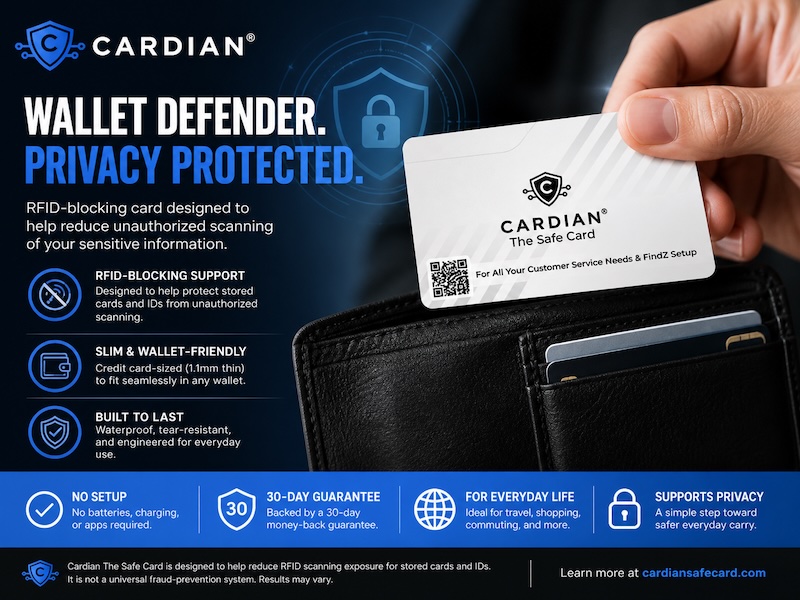
Cardian The Safe Card Introduces a Wallet-Based RFID Blocking Option for Everyday Identity and Privacy Protection
Most people carry at least one contactless payment card every single day. Tap-to-pay credit cards, debit cards, and smart identification documents are now standard in wallets across the country — and all of them use RFID technology to communicate wirelessly with payment readers. That convenience is real. So is the question that naturally comes with it: can a device read that data without your knowledge or consent?
That question is exactly what people are researching when they search for terms like Cardian The Safe Card scam, Cardian The Safe Card complaints, or Cardian The Safe Card under investigation. Those are verification searches — the kind a careful buyer runs before making a purchase decision. They reflect standard consumer due diligence, not confirmed enforcement actions or regulatory findings. Consumers searching for "Cardian Safe Card legit or not," "Cardian Safe Card real or fake," or "is Cardian Safe Card worth it" are doing exactly the same thing: evaluating product credibility before spending money, which is exactly the right instinct.
Cardian The Safe Card is a passive RFID-blocking wallet card designed to help reduce unauthorized contactless scanning exposure for compatible cards and identification documents stored nearby in a wallet. It requires no setup, no charging, and no app. The card is designed to provide ongoing RFID-blocking support while it remains in the wallet — once it is placed in the wallet, without requiring additional action from the user.
View the current Cardian The Safe Card offer (official Cardian The Safe Card page)
Is Cardian The Safe Card a Scam or a Legit Product?
The short answer: there are no confirmed regulatory actions, government findings, or enforcement proceedings associated with Cardian The Safe Card. The "scam," "complaints," and "under investigation" searches that consumers run on this product — and on RFID-blocking products generally — reflect a healthy verification habit, not documented problems.
What those searches actually surface is a product that sits in a crowded consumer electronics category with some big promises attached to it. The RFID-blocking space has historically attracted marketing language that overstates what the technology is designed to do. "Blocks all hackers," "unhackable," "prevents identity theft" — these phrases get applied to passive wallet cards in a way that creates credibility questions, because they reach further than the product is actually built to support.
Cardian The Safe Card does not make those claims here. What the product is designed to do is specific and narrow: help reduce unauthorized RFID scanning exposure for compatible contactless cards stored nearby in a wallet. That is a real, verifiable function. The product is built for consumers who want a physical wallet accessory that addresses that specific concern — nothing more, nothing less.
Consumers who approach Cardian The Safe Card with accurate expectations about what RFID-blocking cards are designed to do — and who understand that no single wallet accessory is a substitute for broader financial security practices — are the ones most likely to find the product useful. That is the honest starting point for any evaluation of this product.
What Cardian The Safe Card Is Designed to Do
Cardian The Safe Card is a consumer RFID-blocking wallet card designed to help reduce unauthorized contactless scanning exposure for compatible cards and identification documents stored in a wallet. Understanding what it is built to do — and what it is not — is the most practical way to decide whether it fits a particular privacy routine.
The card is designed to support stored-card privacy by adding a passive RFID-blocking layer inside a wallet. When compatible payment cards or smart identification documents are stored alongside it, the card is built to help interfere with radio frequency communication between nearby readers and those stored cards.
It is not designed to prevent phishing, database breaches, stolen passwords, online account takeover, merchant fraud, lost physical cards, or every form of identity theft. Cardian The Safe Card is a physical wallet accessory built for one specific purpose: reducing RFID scanning exposure for stored cards during carry. That boundary matters — and it is also what makes the product easy to use. There is no app to configure, no subscription to manage, and no hardware to charge. Slide it into a wallet, and it is designed to begin functioning passively.
Effectiveness may vary depending on wallet configuration, card placement, and proximity to scanning devices. As with all passive RFID-blocking products, real-world performance is influenced by factors including wallet material, card arrangement, and the strength of nearby scanning signals.
How RFID Skimming Works in Real-World Environments
Radio frequency identification works by broadcasting a small electromagnetic field that powers the chip in a contactless card and prompts it to transmit data. Contactless payment cards typically operate within the 13.56 MHz high-frequency RFID range. Passive RFID-blocking cards are designed to disrupt communication in this range by attenuating or redirecting radio signals between the reader and the card. Actual read range varies depending on reader strength, environment, and interference conditions.
In a controlled payment environment — a retail checkout terminal, a transit gate — the reader is fixed, authorized, and positioned at a known distance. In an uncontrolled environment, those parameters are unknown. A small handheld reader can operate within close range in a crowded space without any visible signal that it is active.
The practical concern is not that every crowded space contains active RFID skimmers. It is that contactless cards are designed to respond to any compatible reader that gets close enough — and in environments where physical proximity to strangers is unavoidable, proximity to an unauthorized reader is also possible. Airports, transit systems, hotel lobbies, shopping centers, and large public events are the environments consumers most frequently identify as contexts where passive wallet protection feels relevant.
RFID-blocking cards address this by being designed to sit between the reader's signal and the stored cards. They do not require the user to identify a threat or take action. The blocking is designed to be passive and ongoing while the cards are stored in the wallet.
What Types of Cards Use RFID Technology
Not every card in a wallet uses RFID, and knowing the difference helps set accurate expectations for what an RFID-blocking card is designed to protect.
Contactless payment cards — credit and debit cards with the wireless symbol on the front — use RFID technology and are designed for tap-to-pay transactions. These are among the most commonly carried RFID-enabled documents in a standard wallet.
Smart passports issued by the United States and most other countries contain an embedded RFID chip that stores the passport holder's biographic data and a digital version of the photo page. The chip is designed for use at automated border control readers and e-passport gates, but it responds to any compatible reader in range.
Government-issued ID cards in many states and countries now include RFID chips. Enhanced driver's licenses issued in border states, as well as some national ID cards used in other countries, contain RFID-readable data.
Transit and access cards — employee badges, building access cards, transit fare cards — often use RFID or a closely related contactless technology. Whether a specific card uses RFID depends on the issuer and system.
Cards that use only a magnetic stripe or chip-and-pin technology do not transmit wirelessly and are not affected by, or protected by, RFID-blocking coverage. Cardian The Safe Card is designed for the RFID-enabled cards in a wallet — the ones that are built to respond to a nearby reader.
Why RFID Blocking Remains Relevant for Modern Wallets
Contactless payment adoption has expanded significantly over the past decade. As tap-to-pay became the default for card issuance across the country, consumer awareness of the RFID skimming question grew alongside it. For most people, the shift happened gradually: cards were replaced, tap-to-pay was added, and at some point it became routine to hold a card near a reader rather than swiping or inserting it.
Consumer interest in RFID card protection, contactless card privacy, and wallet RFID protection has grown as a natural result. For consumers who carry multiple contactless cards alongside a smart passport during travel, or who move through dense public transit environments daily, the question of wallet privacy is a practical one. Cardian The Safe Card is designed for consumers who want a physical wallet insert that supports stored-card privacy without requiring them to replace their wallet or change how they make payments.
When RFID Blocking Matters Most
Cardian The Safe Card is designed for common wallet-carry environments where multiple contactless cards are in close proximity during movement through public spaces. These are the situations consumers most frequently identify as contexts where RFID skimming protection and contactless card safety feel most relevant:
Air travel: Airports concentrate large numbers of people carrying contactless payment cards and smart passports in tight, high-traffic spaces. Security lines, gate areas, and baggage claim are all environments where wallets are frequently accessed and carried in close proximity to others.
Daily commuting: Urban transit systems involve physical proximity to other passengers and the constant presence of contactless payment infrastructure. Commuters carrying tap-to-pay cards alongside transit cards represent a natural use case for passive wallet RFID protection.
Shopping and dining: Retail environments involve repeated card access alongside exposure to a variety of payment equipment. Cardian The Safe Card is intended to support stored-card privacy between payment moments — while cards are sitting in the wallet, not being actively used at a terminal.
Hotels and events: Hotels use RFID-based key cards, and large events — stadiums, arenas, convention centers — concentrate high card-carrying populations. These environments combine physical density with frequent wallet access.
International travel: Smart passport holders traveling internationally carry documents that contain biographic data on an RFID chip. In foreign transit environments, wallet RFID protection for stored travel documents is a common concern among frequent international travelers.
For each of these contexts, the core practical point is the same: Cardian The Safe Card is designed to work without disrupting the user's existing payment routine. Contactless transactions are made by removing the card from the wallet and tapping it directly to the reader. Chip-and-pin and magnetic stripe transactions are unaffected entirely.
View the current Cardian The Safe Card offer (official Cardian The Safe Card page)
Cardian The Safe Card Feature Overview
Cardian The Safe Card is built around a straightforward design profile for everyday carry:
- Credit card-sized form factor: Designed with standard payment card dimensions to fit into standard wallet and cardholder slots without requiring a dedicated compartment or sleeve.
- 1.1mm profile: Slim enough to sit alongside existing cards without adding noticeable bulk to the wallet.
- Passive blocking mechanism: Built to operate without batteries, charging ports, app pairing, or activation of any kind. The RFID-blocking function is built into the physical construction of the card itself.
- Waterproof and tear-resistant construction: Built for routine wallet carry and designed to hold up to everyday conditions without degradation of its blocking properties over time.
- Designed to provide ongoing RFID-blocking support during normal wallet use: Because the card is passive and requires no power source, it is intended to be effective throughout the day without a charging schedule or maintenance routine.
Current pricing, multi-pack bundle options, and promotional availability are listed at cardiansafecard.com. Pricing and availability are subject to change.
Common Misconceptions About RFID Protection
The RFID-blocking product category has accumulated a fair amount of marketing language that creates confusion about what these products are and are not designed to do. A few of the most common misconceptions are worth addressing directly.
Misconception: RFID blocking prevents identity theft. RFID skimming is one potential vector for unauthorized card data access. Identity theft occurs through a wide range of channels — phishing, data breaches, social engineering, card-not-present fraud, account takeover — that have nothing to do with contactless card radio signals. A passive wallet card is not designed to address any of those threats. RFID-blocking products are designed for the RFID skimming vector specifically.
Misconception: RFID-blocking products stop all unauthorized scanning. Passive RFID-blocking cards are designed to help interfere with radio frequency communication in the standard contactless payment range. Effectiveness may vary depending on wallet configuration, card placement, and proximity to scanning devices. No passive RFID product can provide absolute performance guarantees across all real-world scanning scenarios.
Misconception: All wallets block RFID automatically. Standard leather, fabric, and synthetic wallets do not provide RFID blocking unless they are specifically designed and marketed for that purpose. Most everyday wallets offer no protection against contactless scanning.
Misconception: RFID blocking interferes with normal card use. Contactless transactions are performed by removing the target card from the wallet and holding it directly to the payment reader — outside the blocking field. Normal payment use is not disrupted.
Cardian The Safe Card is designed for consumers who understand these distinctions and want a practical, passive option for the specific concern of RFID scanning exposure during everyday wallet carry.
Claims Evaluated Through a Compliance-First Lens
Some of the language commonly used to describe RFID-blocking products — "blocks all hackers," "prevents identity theft," "unhackable," "military-grade protection" — reaches further than the technology is designed to support. Cardian The Safe Card is built to do one thing well: help reduce unauthorized contactless scanning exposure for compatible cards stored nearby in a wallet.
That means the product should be understood as an RFID-blocking wallet accessory, not a universal fraud-prevention system. For consumers who want to reduce the RFID skimming exposure vector specifically, the product is designed for exactly that purpose. For broader financial security, Cardian The Safe Card is intended to complement — not replace — standard practices such as monitoring bank alerts, enabling account notifications, using strong passwords, reviewing statements regularly, and reporting suspicious activity to financial institutions.
Consumers who approach Cardian The Safe Card with accurate expectations about what it is designed to do are the ones best positioned to evaluate whether it is the right fit for their routine.
RFID Blocking Cards vs. RFID Wallets and Sleeves
The RFID-blocking product category includes three main form factors. Each fits a different kind of buyer, and the differences are practical rather than a matter of one being universally better than another.
RFID wallets replace the consumer's existing wallet entirely. They incorporate blocking material into the wallet construction itself, which means every card stored inside benefits from the protection. The tradeoff is that the consumer replaces their current wallet setup and takes on the cost and adjustment that comes with it.
RFID sleeves cover individual cards. Each contactless card gets its own sleeve, and protection applies only to cards that are consistently sleeved. For consumers carrying multiple contactless cards, this means managing multiple sleeves and making sure each card is covered before returning it to the wallet.
Flat RFID-blocking cards sit inside an existing wallet alongside existing cards. They are designed to provide RFID-blocking support for nearby cards from a single wallet slot, without requiring the consumer to replace their wallet or sleeve each card individually. Cardian The Safe Card fits into this category.
Each format involves tradeoffs between convenience, coverage, and portability. Flat RFID-blocking cards are often chosen by consumers who prioritize minimal bulk and compatibility with existing wallets, while sleeves and wallets may appeal to users who prefer full enclosure or dedicated card storage. The right choice depends on what a particular consumer values in their daily carry setup.
For consumers who want to keep their current wallet and add a compact RFID card protector rather than replace their setup, the flat-card format is the relevant option to evaluate. Cardian The Safe Card is designed for that buyer.
Who Cardian The Safe Card May Be Appropriate For
Cardian The Safe Card is positioned for consumers who regularly carry contactless payment cards or RFID-enabled identification documents in a standard wallet and want a passive, low-maintenance option for reducing unauthorized scanning exposure during everyday carry.
It is a particularly natural fit for consumers who travel frequently and carry smart passports or RFID-enabled travel documents through busy international transit environments. It is also designed for urban commuters, daily shoppers, and anyone who prefers to add a wallet RFID protection layer without replacing their existing wallet or managing individual card sleeves.
The product is not designed for consumers looking for comprehensive fraud prevention, real-time account monitoring, or protection against non-RFID identity threats. Those functions require different tools. Cardian The Safe Card is a single-purpose physical product built for one job: helping to reduce RFID scanning exposure for stored cards during carry. Multi-pack options are available for households or travel groups where multiple people want individual coverage.
Ordering, Shipping, Returns, and Customer Support
Cardian The Safe Card is available directly through cardiansafecard.com. Orders ship with real-time tracking. Domestic shipping typically takes 7 to 14 business days. International shipping timelines may vary. Full shipping terms are available at cardiansafecard.com.
Cardian The Safe Card includes a 30-day money-back guarantee. Current return terms, applicable conditions, and any cancellation-related fees are detailed in the Terms and Conditions at cardiansafecard.com. Consumers should review current terms before purchase, as policies are subject to change.
Customer support is available at:
- Phone: +1 (833) 930-0707
- Email: support@savvysmartdeals.com
Frequently Asked Questions
What is Cardian The Safe Card?
Cardian The Safe Card is a passive RFID-blocking wallet card designed to help reduce unauthorized contactless scanning exposure for compatible payment cards and identification documents stored nearby in a wallet. It is credit card-sized, 1.1mm thin, and requires no setup, charging, or app pairing to operate.
How does Cardian The Safe Card work?
The card is built using materials designed to attenuate radio frequency signals in the 13.56 MHz range used by contactless payment cards and smart identification documents. When placed in a wallet alongside other cards, it is designed to help interfere with radio frequency communication between nearby readers and those stored cards. Effectiveness may vary depending on wallet configuration, card placement, and proximity to scanning devices.
Does Cardian The Safe Card block all forms of identity theft?
No. Cardian The Safe Card is designed specifically to help reduce unauthorized RFID scanning exposure for stored contactless cards. It is not designed to address phishing, data breaches, account takeover, online fraud, or other identity threats that operate through non-RFID channels. It is intended to complement, not replace, broader financial security practices including monitoring bank alerts, enabling account notifications, and reviewing statements regularly.
Does Cardian The Safe Card require charging or setup?
No charging, app pairing, battery replacement, or activation is required. The card operates passively and is designed to provide ongoing RFID-blocking support during normal wallet use without any maintenance routine.
Can users still make contactless payments while carrying Cardian The Safe Card?
Yes. Contactless payment transactions are made by removing the payment card from the wallet and holding it directly to the payment reader — which takes it outside the blocking field. Chip-and-pin and magnetic stripe transactions are unaffected entirely.
What types of cards may benefit from RFID blocking?
RFID-enabled contactless payment cards, debit cards, and smart passports that operate in the standard 13.56 MHz contactless frequency range are the primary card types an RFID-blocking wallet card is designed to support. Cards that use only chip-and-pin or magnetic stripe technology do not use RFID and are not affected by RFID-blocking coverage.
Is Cardian The Safe Card a replacement for fraud monitoring?
No. Cardian The Safe Card is a physical wallet accessory designed for the specific purpose of reducing unauthorized RFID scanning exposure during carry. It is not a substitute for monitoring bank alerts, reviewing account statements, enabling account security tools, or reporting suspicious activity to financial institutions. Those practices address fraud vectors that a physical wallet card is not designed to reach.
Is Cardian The Safe Card a scam?
There are no confirmed regulatory actions, government findings, or enforcement proceedings associated with Cardian The Safe Card. Consumer searches using terms like "scam," "complaints," or "legit or not" reflect standard verification behavior — not documented problems with the product. Cardian The Safe Card is a passive RFID-blocking wallet card with a specific, narrow function. Consumers who want to evaluate the product are encouraged to review full terms and conditions at cardiansafecard.com.
Where can Cardian The Safe Card be ordered?
Cardian The Safe Card is available at cardiansafecard.com. Current pricing, bundle options, and any active promotional availability are listed on the official product page.
What is the return policy?
Cardian The Safe Card includes a 30-day money-back guarantee from the date of receipt. Full return terms, applicable conditions, and any cancellation-related fees are detailed at cardiansafecard.com. Consumers should review current terms before purchase.
Summary
Cardian The Safe Card is a passive RFID-blocking wallet card designed to help reduce unauthorized contactless scanning exposure for compatible payment cards and identification documents stored in a wallet. At 1.1mm thin and standard credit card dimensions, it fits into standard wallet and cardholder slots without replacing existing card storage or adding noticeable bulk.
The card requires no setup, no charging, and no app. It is built with waterproof and tear-resistant construction for long-term everyday carry. For consumers looking for a compact, low-maintenance RFID card protector — commonly used by frequent travelers, daily commuters, and anyone carrying multiple contactless cards in busy public environments — Cardian The Safe Card is designed to fill that role passively and continuously.
It is not a universal fraud prevention system. It is a single-purpose physical product built for one job: helping to reduce RFID scanning exposure for stored cards during carry. Effectiveness may vary depending on wallet configuration, card placement, and proximity to scanning devices. Cardian The Safe Card is intended to complement broader financial security practices, not replace them.
Current pricing, bundle options, and promotional availability are listed at cardiansafecard.com. Purchases include a 30-day money-back guarantee. Full terms apply.
View the current Cardian The Safe Card offer (official Cardian The Safe Card page)
Recent Cardian The Safe Card Coverage
Cardian The Safe Card has been featured in prior coverage across financial and product-focused publications.
Contact Information
Phone: +1 (833) 930-0707
Email: support@savvysmartdeals.com
East Address: 131 Continental Drive, Suite #305, Newark, NJ 19713
West Address: 2033 San Elijo Ave, Suite #430, Cardiff, CA 92007 USA
Results may vary. Individual experiences and outcomes differ based on product use, card type, wallet setup, environment, and other factors. RFID-blocking products are intended to support stored-card privacy and are not a substitute for broader financial security practices.
Pricing, bundle options, shipping terms, promotional availability, and return terms are subject to change. Consumers should review the official Cardian The Safe Card page and current terms and conditions before purchase.
Marketing Disclosure: This content was produced in connection with a marketing arrangement with Cardian The Safe Card. See full terms and conditions at cardiansafecard.com.

Phone: +1 (833) 930-0707 Email: support@savvysmartdeals.com

Legal Disclaimer:
EIN Presswire provides this news content "as is" without warranty of any kind. We do not accept any responsibility or liability for the accuracy, content, images, videos, licenses, completeness, legality, or reliability of the information contained in this article. If you have any complaints or copyright issues related to this article, kindly contact the author above.
